Broker liability
Freight Broker E&O Renewal: How Documented Carrier Vetting Changes the Conversation
By The Draylo Team · July 25, 2026
The short answer
Insurance renewals price what a brokerage can show, not what it says it does. After the Supreme Court's Montgomery decision put negligent carrier selection squarely in state court, underwriters weigh carrier-vetting procedures more heavily — and unlike your claims history or your lanes, documentation is the renewal factor you fully control.
Why your renewal asks about carrier selection now
A freight brokerage's E&O and contingent-cargo renewal has always asked about operations, but the weight behind one question changed in May 2026. In Montgomery v. Caribe Transport II, a unanimous Supreme Court held that state-law claims against a broker for negligently selecting a motor carrier are not preempted by federal law — they fall inside the FAAAA's safety exception and proceed in state court. The standard those suits apply is ordinary care in selecting the carrier.
That ruling resolved a years-long split in the federal courts of appeals — the Ninth and Sixth Circuits had allowed such claims while the Seventh and Eleventh had blocked them, a divide summarized in the Congressional Research Service's legal sidebar on broker preemption. Resolution means the exposure is now uniform: there is no circuit where a negligent-selection claim is off the table, and no brokerage whose insurer can price it as a regional question.
The concurrence is the part worth reading twice, because it is the calm half of the story. As Crowell & Moring's client alert summarizes, Justice Kavanaugh emphasized that brokers face no liability problem if they have a reasonable carrier-selection policy and ask hard questions of the carrier. The ruling did not make brokers liable for carrier crashes — it made the difference between a documented selection process and an undocumented one legally and financially meaningful.
What underwriters actually weigh — and which factor you control
Underwriting a brokerage is mostly arithmetic on things you can't change by renewal day: claims history, freight mix and lanes, annual volume and revenue. One transportation insurance agency's 2026 breakdown of broker insurance cost factors lists those alongside a different kind of input — the carrier vetting process — which it calls one of the most controllable cost drivers, noting that insurers evaluate onboarding procedures, authority monitoring, and fraud-prevention practices, and that documented carrier qualification procedures have become more important since Montgomery.
The logic is the same one an underwriter applies to any account: a submission that demonstrates its risk controls is priced on evidence; one that describes them from memory is priced on uncertainty. Claims history takes years to improve and your lanes are your business — the documentation of how carriers get selected is the one renewal input a brokerage can transform in a quarter.
This is not a promise that a binder of records cuts your premium some specific amount — pricing is multi-factor, markets harden and soften, and no honest article can tell you what your quote will be. What the sources support is narrower and more useful: carrier-selection procedure is a factor underwriters weigh, it moved up the list after Montgomery, and it is the factor where the brokerage, not the market, holds the pen.
The gap between vetting and being able to prove it
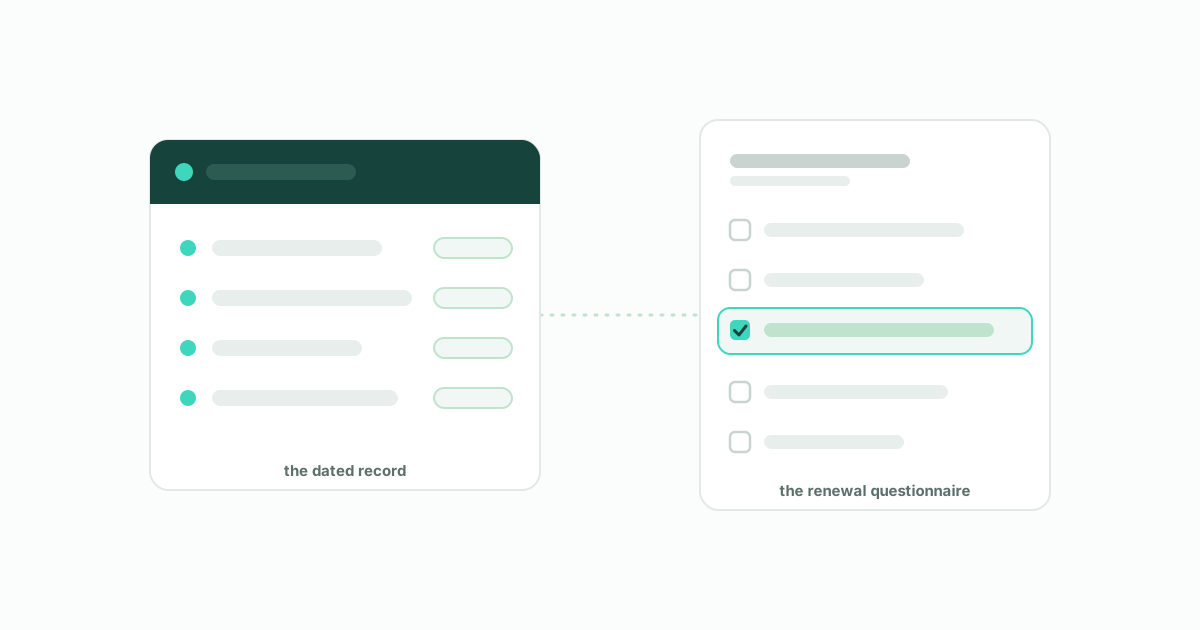
Most established brokerages already vet: a SAFER lookup, a COI in the inbox, a call to a reference. The renewal problem is rarely the vetting — it's that the evidence lives in browser history, email threads, and memory. "We always check" is a description; a dated record of what was checked, what it showed, and who decided is an exhibit. Underwriters, like courts, work from exhibits.
The industry's own reference point for what a real process looks like is the Transportation Intermediaries Association's Carrier Selection Framework — an 80-page guide TIA describes as the definitive doctrine on carrier selection, built by brokerage operators, transportation attorneys, and insurance experts. Its throughline matches what insurers evaluate: a written qualification procedure, verification of operating authority and insurance against the federal record, and periodic re-checks rather than one-and-done clearance.
A documented selection process, concretely, produces four things per carrier: the date each check ran, what the federal record and documents showed at that moment, the decision made, and — where a broker proceeded past a flag — the rationale. If any of those four lives only in someone's head, the process exists but the proof doesn't.
What to assemble before renewal season
Renewals reward preparation that starts before the application arrives. The list is short:
- ›A one-page written carrier-selection procedure — what gets checked, in what order, and what disqualifies. If you follow a process, writing it down costs an afternoon; underwriters and defense counsel both start by asking for it.
- ›Dated per-carrier records — evidence that the procedure actually runs: when each carrier was checked, what the record showed, who approved.
- ›Evidence of ongoing monitoring — authority and insurance change mid-relationship; showing you watch for revocations and coverage lapses after onboarding addresses the question underwriters ask next.
- ›A book-wide summary — carrier counts, verdicts, open issues, decisions on file. One document that answers "describe your carrier base and how it's managed" without a scramble.
- ›One question for your own insurance broker: ask what documentation would strengthen your submission this year. Every market is different, your broker knows yours, and the answer costs nothing — it also tells you exactly which of the above to prioritize.
Where a vetting platform fits
The reason documentation usually doesn't exist isn't negligence — it's that assembling it by hand is clerical work nobody has time for mid-freight. That is the specific problem a vetting platform solves: run the same checks you already run, and the record assembles itself. In Draylo, every carrier check is saved as a dated, tamper-evident record; any carrier's audit record can be shared with an underwriter or shipper as a read-only link on every plan; and the book-wide compliance report — carrier counts, verdict breakdown, insurance status, open issues, one PDF — is generated on demand for exactly the renewal conversation this article describes. The checks don't change; the proof starts existing.
And if the sticking point is the book you already run — real carriers, real history, paperwork scattered across inboxes — that exact afternoon of work has a step-by-step screenshot walkthrough: import the book, walk every carrier with nothing on file, and attach what you already hold.
Frequently asked questions
Will documented carrier vetting lower my E&O premium?
No one can honestly promise a specific premium outcome — pricing weighs claims history, freight mix, volume, and market conditions alongside your controls. What insurance sources do support: carrier-vetting procedure is an underwriting factor, it gained weight after the Montgomery decision, and unlike your claims history it is fully within your control before renewal. Ask your own insurance broker what documentation would strengthen your specific submission.
What did Montgomery v. Caribe Transport actually decide?
The Supreme Court held unanimously in May 2026 that state-law claims alleging a broker negligently selected an unsafe motor carrier are not preempted by the FAAAA — they fall within its safety exception and can proceed in state court under an ordinary-care standard. It did not make brokers automatically liable for carrier crashes; Justice Kavanaugh's concurrence emphasized that brokers with a reasonable selection policy who ask hard questions of carriers should not face a liability problem.
What's the difference between E&O and contingent cargo insurance for a broker?
E&O (errors and omissions) covers claims that the brokerage's professional performance — including carrier selection — caused a loss. Contingent cargo responds when cargo is lost or damaged and the motor carrier's own cargo policy doesn't pay. Both are underwritten partly on how the brokerage selects and monitors carriers, which is why both renewals ask about the process.
What should a written carrier-selection procedure include?
The industry reference is TIA's Carrier Selection Framework. In practice a defensible procedure covers: verification of operating authority against the federal record, insurance verification (filing and certificate), safety data review, disqualifying criteria, out-of-band contact verification for fraud prevention, who approves exceptions and how the rationale is recorded, and a re-check cadence for active carriers — with each step producing a dated record.
When does a brokerage's insurance renew?
Typically annually, and for many brokerages the package renews around the anniversary of when authority was set up, since the bond and policies were first bound together at registration. The practical implication: the time to assemble documentation is 60–90 days before that anniversary, when underwriting submissions and questionnaires actually get prepared — not the week the renewal lands.
Get the next guide in your inbox
Practical guides like this one — carrier fraud, broker liability, vetting that holds up. One email when a new guide publishes; no list-blasting, unsubscribe with one reply.
Keep reading
- ›the step-by-step version — how to put an existing carrier book on the record
- ›the legal side in depth — what "ordinary care" now requires after Montgomery
- ›what a defensible carrier file should contain — the vetting documentation checklist
- ›the practical read for a 1–5 person shop — what Montgomery means for small brokers
- ›finding the rot in an existing carrier book — lapsed authority and insurance