Broker liability
You Hold the Liability, So You Should Hold the Controls: The Case for Broker-Chosen Vetting
By The Draylo Team · July 17, 2026
The short answer
Not every load carries the same risk, so vetting every carrier the same way is wrong in both directions — over-vetting cheap loads wastes time and pushes carriers away, under-vetting high-value loads is where the real losses happen. And because the Montgomery ruling puts the liability for carrier selection on the broker, the broker — not a platform — is the party who should decide how deep to vet each load. You can't delegate the liability, so you shouldn't be forced to delegate the judgment.
The short version
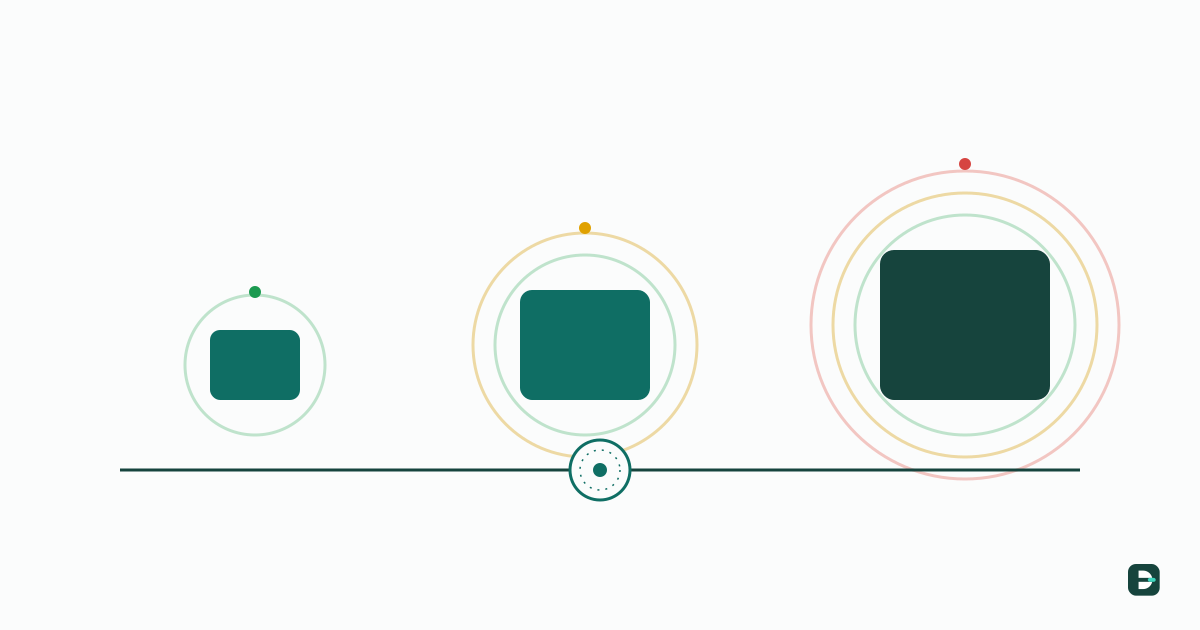
A $500 pallet of paper towels and a $200,000 truckload of electronics do not carry the same risk, so vetting the carriers behind them the same way is a mistake in both directions: you over-vet the cheap load (wasting time and adding friction that pushes good carriers away) and you under-vet the expensive one (which is exactly where a stolen load actually hurts). Vetting depth should scale with what's at stake. That's not a shortcut — it's how risk management works everywhere else, and it's how experienced brokers already think.
There's a second, deeper reason the depth should be your call and not a platform's. After the Supreme Court's 2026 Montgomery decision, the legal liability for negligently selecting a carrier sits with the broker. You are the one who gets sued. And the party who holds the liability is the party who should hold the controls — because you can't delegate the liability, so you shouldn't be forced to delegate the judgment that shapes it.
Why one-size-fits-all fails in both directions
The instinct behind mandatory, uniform vetting is understandable: fraud is real and rising, so check everything hard. But applied to every load equally, it breaks down on contact with how brokerages actually run.
Over-vetting has a cost people underestimate. Heavy verification on a low-risk load — a cheap commodity, an established carrier, a short lane — burns time you don't have and adds friction the carrier feels. Carriers have options; the ones who don't want to jump through hoops for a milk run simply take someone else's load. Working brokers say this out loud: run the full gauntlet on every tender at real volume and it stops being vetting and starts being a bottleneck.
Under-vetting is the opposite failure, and it's the expensive one. The same broker running light on everything to keep up will, sooner or later, wave through the high-value load that a fraud ring was actually targeting — because the sophisticated scams aim at the freight worth stealing. Uniform vetting that's light enough to scale is too light where it counts, and uniform vetting that's heavy enough to catch fraud is too heavy to scale. There is no single depth that's right for every load, because loads aren't the same.
The liability doesn't move — so the control shouldn't either
Here is the part that should decide the question. In Montgomery v. Caribe Transport II, LLC (U.S. 2026), the Court held that a broker can be sued under state law for negligently selecting an unsafe carrier. The duty of ordinary care in carrier selection is the broker's. Not the load board's, not the vetting vendor's — the broker's.
That has a direct consequence for how vetting tools should work. If a platform mandates a fixed set of checks on every carrier, it is making a risk judgment on behalf of the party who carries the legal exposure for that judgment — and then handing the consequences back to the broker if it's wrong. The broker can't say in court, "the platform decided." The duty was always theirs. So a tool that removes the broker's discretion doesn't remove the broker's liability; it just separates the two, which is the worst of both worlds: you own the outcome but not the decision.
The coherent position is the reverse. Because the liability is non-delegable, the judgment should be non-removable. The broker should be able to decide — per load, per lane, per carrier — how much verification a given tender warrants, and stand behind that decision with a documented rationale. Autonomy here isn't a convenience feature; it's the only arrangement that matches where the law actually puts the responsibility.
Defense in depth, applied proportionally
"Defense in depth" is a security idea worth borrowing precisely: you protect something with layers, and you apply more layers to the things that would hurt more to lose. Nobody puts a vault door on a supply closet. The point isn't maximum security everywhere — it's the right amount of security in the right places, decided by the person who owns the asset.
For carrier vetting, the base layer is non-negotiable and runs on everything: is the authority active, is the carrier allowed to operate, is insurance on file, does the federal record raise any red flags. That floor isn't where the choice lives — you always do at least that. The choice lives in the layers above it: out-of-band contact verification, an identity-coherence check on a newly registered carrier, confirming the VIN and CDL at pickup, holding the load to a higher insurance minimum. Those are the layers a broker adds when the load earns them — and leaves off when it doesn't.
A practical way to decide how deep to vet
You don't need a formula, just a consistent way of reading each load. Four factors tell you where a tender sits on the risk scale, and therefore how many layers it warrants:
- ›Load value — the higher the declared value, the more a theft costs you and the more attractive it is to a sophisticated fraud. High value pulls toward more layers.
- ›Commodity desirability — electronics, pharma, liquor, and other easily-resold goods are theft targets regardless of raw value; a low-value load of a hot commodity still earns scrutiny.
- ›Carrier newness — an established carrier with a long clean record is a different risk than an authority registered weeks ago; new entities are where identity-takeover and chameleon scams live, so they earn the coherence checks.
- ›Lane and circumstance — long hauls, known theft corridors, and loads you're covering under time pressure (the conditions fraud rings exploit) all argue for more verification, not less.
What this looks like in practice
The workable version isn't deciding all of this fresh on every load — that's just friction by another name. It's setting your policy once and applying it consistently: define what a standard load gets, what a high-value load gets, what a new carrier gets, and let those apply by default, with the ability to dial a specific tender up when something about it warrants a closer look. Consistency is itself part of the defense — a documented, repeatable policy applied the same way every time is what ordinary care looks like in evidence.
That's the model Draylo is built around: an always-on base every carrier clears, plus optional layers you compose into the vetting policy that fits your book — because you're the one holding the liability, so you're the one who should hold the controls. The floor keeps you safe; the layers are yours to choose. If you want the legal backdrop first, start with what "ordinary care" now requires after Montgomery, and for the record that makes a documented decision defensible, see what a defensible carrier file looks like.
The broker this actually matters most for
Layered, risk-scaled vetting isn't a new idea — the enterprise compliance platforms have offered versions of it for years. The catch is who they built it for. Those tools are priced and shaped for large brokerages with a compliance team to run them: a portal to roll out, a contract to sign, and a monthly bill that only pencils out at scale. If you run a small shop, that door has mostly been closed to you — not because you didn't need the protection, but because the protection was packaged for someone else.
And the small shop is not a niche — it's the industry. Of roughly 30,000 active freight brokerages in the U.S., only about 1,000 clear $10 million a year; the top few percent capture the large majority of the revenue. The other ~29,000 — the overwhelming majority of brokerages in the country — are small operations. Some are brand-new, weeks past getting their authority, with no infrastructure yet. Many others are experienced, established shops that run lean on purpose and have no intention of becoming a mega-broker. Different stories, same reality: the same personal liability the big brokerages carry, without the compliance department, and — until now — without access to the tooling that manages it.
That's the gap this is built to close. The point of an always-on base plus broker-composed layers, at a small-broker price with nothing to roll out, is to put the kind of proportional, defensible vetting the large shops have always had into the hands of the broker who's carrying the same risk with a fraction of the resources. You hold the liability whether you're broker number one or broker number twenty thousand — so you should be able to control the depth of your defense either way.
Frequently asked questions
Should I vet every carrier the same way?
No. Loads don't carry the same risk, so uniform vetting is wrong in both directions — over-vetting low-risk loads wastes time and pushes carriers away, and vetting light enough to scale leaves your high-value loads under-protected, which is where the real losses happen. A base level of verification should run on every carrier, and additional layers should scale with the load's value, commodity, the carrier's newness, and the lane.
Why should the broker decide vetting depth instead of the platform?
Because the broker holds the liability. After the Supreme Court's 2026 Montgomery ruling, the duty of ordinary care in carrier selection is the broker's — the broker is the one who can be sued. A platform that mandates fixed checks makes a risk decision on behalf of the party who carries the legal exposure, then leaves that party holding the consequences. Since the liability can't be delegated, the judgment that shapes it shouldn't be removed from the broker either.
How do I decide how deep to vet a given load?
Read four factors: load value (higher value earns more scrutiny), commodity desirability (electronics, pharma, and other easily-resold goods are theft targets even at lower value), carrier newness (recently registered authorities are where identity-takeover scams live), and lane/circumstance (long hauls, theft corridors, and time-pressured coverage argue for more verification). Set a policy once for standard, high-value, and new-carrier loads, and apply it consistently.
Doesn't heavier vetting just create friction that scares carriers off?
It does — when it's applied to every load indiscriminately. That's exactly why depth should be proportional. Reserve the heavier layers for the loads that warrant them and keep low-risk tenders light, and you get the protection where it matters without adding friction where it doesn't. The goal isn't maximum vetting; it's the right vetting for each load.
Is risk-based, broker-controlled vetting only for large brokerages?
It's historically been packaged that way — the enterprise compliance platforms priced layered vetting for large shops with a compliance team. But small brokerages are the vast majority of the industry (roughly 29,000 of about 30,000 U.S. brokerages are small operations) and they carry the same personal liability with far fewer resources. That applies equally to a broker weeks past getting their authority and to an experienced shop that runs lean by choice. The point of an affordable, always-on base plus broker-composed layers is to make proportional, defensible vetting accessible to that broker, not just the enterprise.
What is the base level of vetting that should always run?
At minimum, every carrier should be checked for active operating authority, allowed-to-operate status, insurance on file, and any red flags on the federal record — the checks that ordinary care clearly requires regardless of load. That floor is non-negotiable. The optional layers (out-of-band contact verification, new-entity coherence checks, VIN/CDL confirmation at pickup, elevated insurance minimums) are what a broker adds on top when a specific load earns them.
Get the next guide in your inbox
Practical guides like this one — carrier fraud, broker liability, vetting that holds up. One email when a new guide publishes; no list-blasting, unsubscribe with one reply.
Keep reading
- ›the ruling that puts the liability on you — what "ordinary care" now requires after Montgomery
- ›the practical read for a small shop — what Montgomery means for small freight brokers
- ›the record that makes a documented decision defensible — the defensible carrier file
- ›the fraud the heavier layers defend against — anatomy of a double-brokering attempt