Vetting how-to
How to Read a COI (Certificate of Insurance) as a Freight Broker — Field by Field
By The Draylo Team · July 19, 2026
The short answer
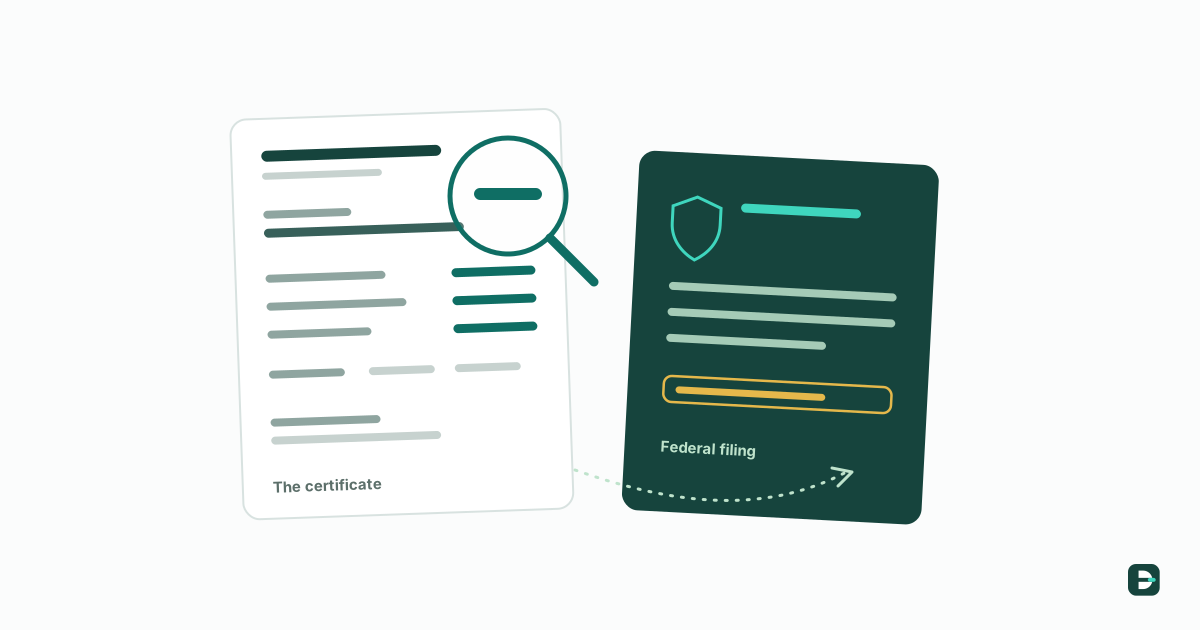
Reading a COI comes down to four look-ups: (1) the named insured must exactly match the carrier's FMCSA legal name, (2) the coverage types and limits must meet the minimums your shipper contracts require, (3) the policy dates must cover your load, and (4) the fine print — certificate holder and cancellation language — must actually involve you. Then remember what a COI is: a snapshot of coverage on the day it was issued, not proof of coverage today. The second layer of the check — the carrier's federal insurance filing — is where cancellations actually show up.
The short version
A certificate of insurance (COI) is the one-page summary a carrier hands you to show they're insured — almost always on the ACORD 25 form, issued by the carrier's insurance agent. Reading one isn't hard, but new brokers routinely read it wrong in the same two ways: they check that a number is big enough without checking WHOSE insurance it is, and they treat the piece of paper as proof of coverage. It's neither an identity check nor proof — unless you make it one.
This walkthrough goes field by field in the order that catches problems fastest: the named insured, the coverage types and limits, the dates, and the fine print — then the step most brokers skip, checking the certificate against the carrier's federal insurance filing. Screenshots use Draylo's free COI reader on a sample certificate, but the reading skill is the same whether a tool extracts the fields or you read them off the PDF yourself.
What a COI is — and what it isn't
A COI is issued by the carrier's insurance agent (the "producer") as a courtesy summary of the policies in force on the day it was printed. It is informational only: it confers no rights on you, it doesn't amend the policies, and nothing about holding it means the coverage still exists tomorrow. A policy can be cancelled for non-payment the week after a perfectly genuine certificate was issued — and the certificate in your inbox doesn't change or expire when that happens.
It can also simply be fake. Certificates are ordinary PDFs, and the FMCSA itself warns that fraudulent certificates circulate — a convincing letterhead and a real insurer's name prove nothing. That's why the certificate is layer one of a two-layer check, never the whole check. Keep that frame in mind for everything below.
Before you read: know your minimums
You can't judge a limit without knowing what you require. Your minimums usually come from your shipper contracts — many demand at least $1,000,000 in auto liability and $100,000 in cargo coverage, and specific freight (reefer, high-value, hazmat) often carries extra requirements like reefer-breakdown coverage or higher cargo limits. Write your minimums down once, and read every certificate against them — not against a gut feeling that a million sounds like a lot.
If you use the free COI reader, you set those minimums right above the upload — the extracted certificate is then checked against your numbers, not generic ones.
Field 1 — the named insured must match the carrier you vetted
The first field to read is not a number: it's the NAMED INSURED — the legal entity the policies actually cover. It must match, exactly, the FMCSA legal name of the carrier you vetted and intend to pay. Not roughly, not "same guys, different LLC" — exactly, or with a documented DBA you've verified.
A mismatch here is the classic double-brokering and identity-theft tell: someone books the load as Carrier A but sends you Carrier B's (real, valid) certificate. Every number on that certificate can be genuine and none of it covers your load, because the entity hauling your freight isn't the entity insured. When the named insured doesn't match the authority you vetted, stop — that's not a paperwork nit, it's a different company.
Field 2 — coverage types and limits
Three coverage types matter on a trucking COI. AUTOMOBILE LIABILITY is the big one — it covers bodily injury and property damage the truck causes, usually expressed as a combined single limit (CSL); interstate carriers are federally required to carry it. MOTOR TRUCK CARGO covers the freight itself — note the limit AND the deductible, and know that cargo policies commonly carry exclusions (unattended-vehicle clauses, certain commodities). COMMERCIAL GENERAL LIABILITY covers non-auto operations; some shippers require it, some don't.
Read each limit against your minimums, and watch the details a skim misses: a $100,000 cargo limit with a $10,000 deductible is not $100,000 of protection on a $95,000 load; reefer loads need the reefer-breakdown line to actually appear; and an "aggregate" limit is a policy-period total that prior claims may already have eaten into — the certificate can't tell you how much of it is left.
Field 3 — the dates
Every policy line carries an effective date and an expiration date. The obvious check: your load must fall inside the window, and an expired line is a stop, full stop. The less obvious check: the certificate's own issue date. A certificate printed eight months ago tells you about coverage eight months ago — ask for a freshly issued one rather than accepting whatever PDF has been circulating in the carrier's email.
And remember the trap from earlier: an unexpired date does not mean the policy is still in force. Expiration is when the policy was SCHEDULED to end — cancellation can happen any day before it.
The fine print — certificate holder and cancellation language
The CERTIFICATE HOLDER box should name your brokerage — it means the certificate was issued to you, not recycled from someone else's file, and if the policy provides for notice of cancellation, that's who notice goes to. Modern ACORD language is deliberately weak here: "notice will be delivered in accordance with the policy provisions" promises nothing unless the underlying policy actually provides for it. Treat cancellation notice as a nice-to-have, never a safety net.
If your shipper contract requires you or the shipper to be an ADDITIONAL INSURED, look for that in the description of operations — and know that the certificate merely claims it; the endorsement on the actual policy is what grants it.
Layer 1 check: the certificate against your minimums
With the fields read, the layer-one verdict is mechanical: does every required coverage type appear, does every limit meet your minimum, do the dates cover your load, does the named insured match the carrier? Any miss is a conversation with the carrier before tender — not after the load is rolling.
Layer 2 check: the federal filing — where cancellations actually show up
Here's the piece that separates brokers who get burned from those who don't: interstate carriers must have liability insurance ON FILE with the FMCSA, and insurers are required to notify the FMCSA before that filing is cancelled. That means the federal record — not the certificate — is where a dying policy shows up first. A carrier whose insurer has already filed to cancel can still hand you a spotless COI, truthfully issued weeks ago.
So finish every certificate read with a filing check: does the carrier have active BIPD (liability) coverage on file, and is there a pending cancellation? The free insurance lapse check runs exactly that against the live federal record — and if you're using the certificate's expiration date as your reminder to re-check, it will tell you how much runway is actually left.
The traps that burn new brokers, in one list
Reading a stale certificate as current coverage. Accepting a named insured that doesn't match the FMCSA legal name. Counting a cargo limit without subtracting the deductible. Missing an exclusion that guts cargo coverage for your commodity. Booking a reefer load against a certificate with no reefer-breakdown line. Trusting cancellation notice that the policy never actually promised. And the big one: never checking the federal filing at all. Every one of these is a thirty-second read once you know to look — that's the entire skill.
One habit ties it all together: save the certificate you read, the date you read it, and what you decided. After Montgomery, a dated record of your insurance verification is part of your ordinary-care defense — the reading is for your freight; the record is for you.
Frequently asked questions
Is a COI proof that a carrier is insured?
No. A COI is an informational snapshot of coverage as of its issue date, issued by the carrier's agent as a courtesy. The policy behind it can be cancelled the next day without the certificate changing, and fraudulent certificates circulate. Verify the certificate's contents against your minimums, then check the carrier's federal insurance filing — where insurers must record cancellations.
What insurance limits should a freight broker require from a carrier?
Your shipper contracts govern. Common baseline requirements are $1,000,000 in auto liability and $100,000 in motor truck cargo, with extra requirements for specific freight — reefer-breakdown coverage for temperature-controlled loads, higher cargo limits for high-value freight. Set your minimums once and read every certificate against them.
What does 'named insured' mean on a COI, and why does it matter?
The named insured is the legal entity the policies cover. It must exactly match the FMCSA legal name of the carrier you vetted and intend to pay — a mismatch usually means you're looking at a different company's insurance, the classic double-brokering pattern where every number on the certificate is real and none of it covers your load.
How can I tell if a COI is fake?
You usually can't from the document alone — it's an ordinary PDF. Cross-check instead: the named insured against the FMCSA record, the coverage against the carrier's federal liability filing, and, for high-stakes loads, verify with the producer (the issuing agency) using contact details you look up independently — never the phone number printed on a certificate you're suspicious of.
What's the difference between the COI and the carrier's FMCSA insurance filing?
The COI is a courtesy summary from the carrier's agent; the FMCSA filing is the insurance the law requires interstate carriers to keep on file with the federal government. Insurers must notify the FMCSA before cancelling a filed policy, so pending cancellations appear on the federal record while an already-issued certificate still looks clean. Read the certificate for limits and identity; read the filing for whether coverage is actually alive.
Get the next guide in your inbox
Practical guides like this one — carrier fraud, broker liability, vetting that holds up. One email when a new guide publishes; no list-blasting, unsubscribe with one reply.
Keep reading
- ›layer 2 in depth — checking a carrier's real insurance status when the COI date isn't proof
- ›where the insurance read fits in your first full vet — step by step with screenshots
- ›the full 8-step vetting checklist this read belongs to
- ›the fraud a named-insured mismatch is telling you about — anatomy of a double-brokering attempt