Vetting how-to
The Carrier Vetting Process: A Freight Broker's End-to-End Map
By The Draylo Team · July 17, 2026
The short answer
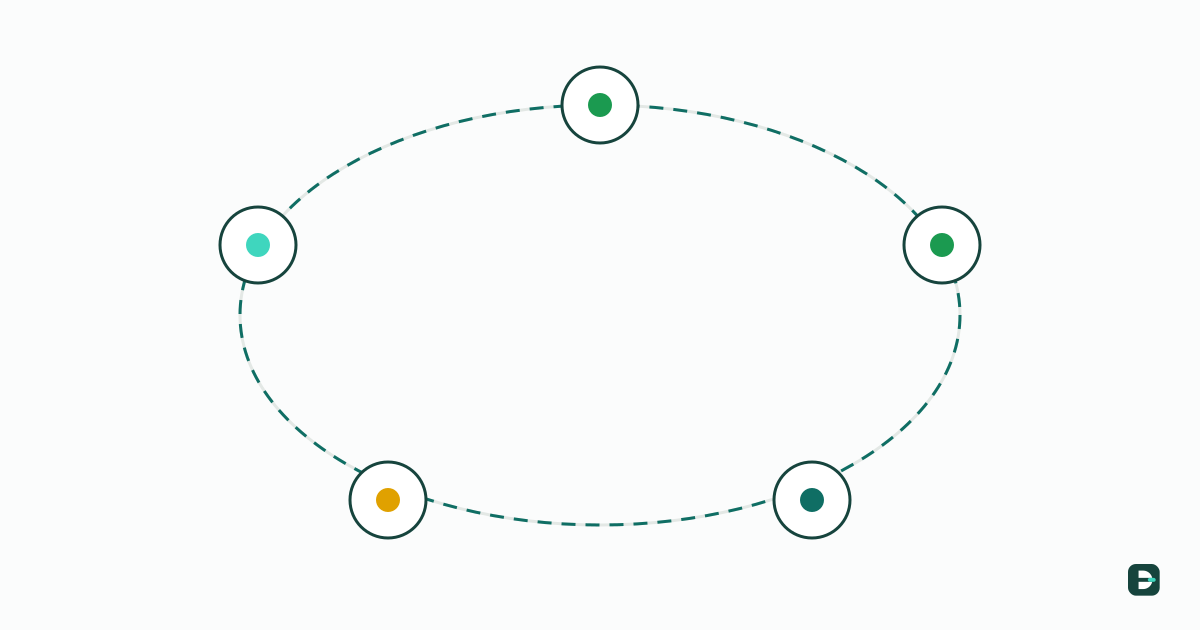
The carrier vetting process is a repeatable five-phase lifecycle a broker runs on every load — identify the carrier, verify it against the live FMCSA record, assess the risk, document the decision the day you make it, and monitor the carrier after you clear it. It is a loop, not a one-time gate: clearance is a snapshot that decays as authority, insurance, and safety status change.
What the carrier vetting process is
The carrier vetting process is the repeatable set of steps a freight broker runs to confirm a carrier is real, authorized, insured, and safe to hand a load to — and to keep confirming it after the load is booked. At full altitude it has five phases: identify the carrier, verify it against the live FMCSA record, assess the risk you're taking, document the decision at the time you make it, and monitor the carrier for changes afterward. The important part is that it is a lifecycle, not a one-time gate: a carrier you cleared this morning can have its authority revoked, its insurance lapse, or an out-of-service order land this afternoon. A vetting process that ends at tender isn't a process — it's a single snapshot that starts decaying the moment you take it.
This page is the map. Each phase below is two or three sentences of what it is and why it exists, then a link to the post that covers it in full. For the ordered, do-this-then-that version — the one you follow on your first loads — see the step-by-step new-broker vetting checklist. This page is the overview that checklist hangs under: what the process is and how the pieces fit.
Why the process itself is now the defense
There are two reasons this is a defined process and not a gut check. Commercially, fraud groups deliberately target brokers who skip steps under load-cover pressure, and the losses have moved from stolen trucks to stolen identities — double-brokering, MC-number takeover, and carrier impersonation. Legally, after the Supreme Court's 2026 decision in Montgomery v. Caribe Transport II, LLC, a broker can be sued under state law for negligently selecting an unsafe carrier, so "ordinary care" in carrier selection is now a live standard nationwide.
The practical consequence is that the process is the artifact. A vetting workflow run identically on every load and documented at decision time is what "ordinary care" looks like in evidence — consistency and contemporaneous records are load-bearing parts of the process, not admin afterthoughts. For the legal detail, see what "ordinary care" now requires after Montgomery; for the fraud detail driving the identity-verification phase, see what the 2025 cargo-theft and carrier-fraud data shows.
Phase 1 — Identify
Start by pinning down exactly which entity you're dealing with: the USDOT/MC number, the legal name, and the address of the carrier the load offer claims to come from. This is the anchor everything else is verified against, so getting the right entity matters before you check anything about it. Identity fraud lives in this phase — the number on the offer and the company actually behind it are not always the same party.
Phase 2 — Verify
Verify that entity against the live FMCSA record: active operating authority, allowed to operate, no out-of-service order, and insurance on file. Two things are worth stating once at overview altitude. First, insurance has two layers — a certificate of insurance only proves coverage on its issue date and can even be fraudulent, so the carrier's federally filed liability status (which insurers update on cancellation) is the stronger signal. Second, verify the contact out-of-band: the FMCSA tells brokers to confirm a company's phone number via SAFER and, if the number they were given doesn't match, to call the number posted in SAFER instead.
For the field-by-field read of the FMCSA record, see what to check before you tender. For the insurance-timing layer, see how to check if a carrier's insurance is about to lapse. For the identity and impersonation angle, see how to check if a carrier is legit and not double-brokering.
Phase 3 — Assess
Verification tells you what the record says; assessment is the judgment you make from it. Weigh the risk factors together — how new the authority is, safety history, insurance adequacy against your minimums, and any mismatch between the offer and the federal record — and decide whether this carrier gets this load. A brand-new authority isn't an automatic disqualifier, but it earns closer scrutiny; the point of the phase is a defensible decision, applied by the same criteria every time.
Phase 4 — Document
Record what you checked and why you proceeded, dated the day you tendered — the FMCSA data you reviewed, the insurance you verified and how, the criteria you applied, and any red flags with your reasoning. This is the phase most brokers treat as optional and the one the Montgomery standard turns into evidence: a note written at decision time is an exhibit, a recollection reconstructed in a deposition is not. For what that record should actually contain, see what a defensible carrier file looks like.
Phase 5 — Monitor
Clearance is a snapshot, so the process loops back on itself: authority gets revoked, insurance lapses, and out-of-service orders land after you've already cleared a carrier. Monitoring is a phase of vetting, not a feature bolted onto it — re-verify the federal record before tendering to a carrier you haven't used recently, and watch active carriers for material changes. A calendar reminder beats nothing; daily automated monitoring beats a calendar. During the FMCSA registration transition to Motus, you may also see a live carrier flagged inactive by a tool that hasn't caught up; the Motus-transition post covers reconciling that mismatch.
The process is the same at every price; what changes is the tool
A real vetting process requires the same things regardless of who you are: read the federal record, read the COI, keep a dated trail, and monitor daily. That standard of care doesn't scale with your software budget. The enterprise carrier-vetting suites bundle these capabilities at a very different price — Descartes MyCarrierPortal publishes a Standard plan at $515/month, while Highway and RMIS are quote-based and don't publish pricing at all.
Draylo does the same four things — live FMCSA reads with a red/yellow/green verdict, COI reading, an append-only audit trail, and daily monitoring, on every paid tier — starting at a public $49/month (Starter), with four tiers to $749 that scale carrier volume and seats rather than the standard of care. The point isn't that cheaper is better; it's that the process is the same regardless of tool tier. What a small broker buys up-market is workflow polish and integrations, not a different standard of care. State the price gap as evidence and let the product speak.
Frequently asked questions
What is the carrier vetting process?
It's the repeatable set of steps a freight broker runs to confirm a carrier is real, authorized, insured, and safe to give a load to — and to keep confirming it afterward. At overview level it's five phases: identify the carrier, verify it against the live FMCSA record, assess the risk, document the decision the day you make it, and monitor for changes. It's a loop run on every load, not a one-time check.
Is carrier vetting a one-time check or an ongoing process?
Ongoing. Clearing a carrier is a snapshot that decays — authority can be revoked, insurance can lapse, and out-of-service orders can land after you've already booked. That's why monitoring is a phase of the process, not an optional add-on: re-verify the federal record before reusing a carrier and watch active carriers for material changes.
What are the phases of the carrier vetting process?
Five: identify (pin down the exact USDOT/MC entity), verify (check the live FMCSA record for authority, status, out-of-service, and insurance, and confirm contact out-of-band), assess (judge the risk and decide), document (record what you checked and why, dated at decision time), and monitor (re-verify and watch for changes after clearing the carrier).
Why does the vetting process matter legally?
After the Supreme Court's 2026 Montgomery v. Caribe Transport II decision, a broker can be sued under state law for negligently selecting an unsafe carrier, making "ordinary care" in carrier selection a live nationwide standard. A process run identically every load and documented at decision time is the practical evidence that you exercised that care.
Do I need expensive software to run a real vetting process?
No. The standard of care is the same regardless of tool: read the federal record, read the COI, keep a dated trail, and monitor daily. Enterprise suites price higher — Descartes MyCarrierPortal publishes a $515/month Standard plan, while Highway and RMIS are quote-only — but the process is the same at any tier. Draylo does the same four things starting at a public $49/month (Starter), on every paid tier.
Get the next guide in your inbox
Practical guides like this one — carrier fraud, broker liability, vetting that holds up. One email when a new guide publishes; no list-blasting, unsubscribe with one reply.
Keep reading
- ›the step-by-step version for your first loads — the new freight broker carrier vetting checklist
- ›the verify phase in full — a field-by-field read of the FMCSA record before you tender
- ›the document phase in full — what a defensible carrier file contains
- ›the identity phase in full — how to tell a legit carrier from a double-brokering impostor
- ›why the process is the defense — what "ordinary care" now requires after Montgomery